
Reviewed · ANCIENT CITIES & TEMPLES
Half day tour – in Sacred city of Anuradhapura Or sacred city of Mihintale.
Anuradhapura is easiest to understand when someone connects its scattered ruins into one story. With licensed guide Lampa, you visit sacred Buddhist sites, ancient bathing pools, royal buildings, and carved stone details rather than simply ticking off monuments. The Jaya Sri Maha Bodhi gives the morning its spiritual focus, while the great stupas show the scale of the old capital.
I like the private format, since only your group takes part, and I like that Lampa explains both Buddhism and Sri Lankan history in clear English. The main caution is timing: 11 stops in three to four hours makes this a brisk introduction, and admission fees are not included in the $30 price.
Key points to know before booking
- A licensed local guide: Lampa leads the tour and explains monuments, Buddhist traditions, and Sri Lankan history in English.
- Eleven important sites: The route includes the sacred Bodhi tree, major stupas, ancient pools, forest monastery ruins, and carved moonstones.
- Private touring: Your group takes part on its own, which gives you more room to ask questions and set the pace within the available time.
- A modest starting price: At $30 per person, the tour includes snacks and water, but not entrance fees or an air-conditioned vehicle.
- A full morning of walking and sightseeing: The scheduled start is 8:30 am, with the tour ending back at the meeting point.
- A useful first look at Anuradhapura: This works best if you want historical context and the main sacred sites without committing to a full-day visit.
Why Anuradhapura works best with a guide
Anuradhapura is not one compact ruin that you can understand in a single glance. It is a large sacred area filled with monuments from different periods, and the meaning of each site matters as much as its appearance.
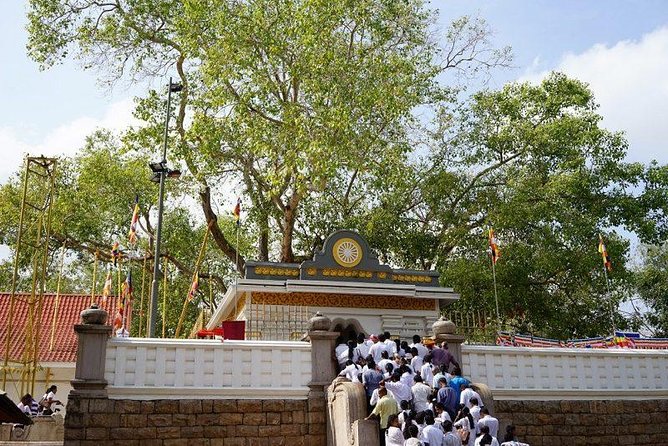
The Jaya Sri Maha Bodhi is a good example. This sacred Ficus religiosa tree is described as the closest authentic living link to Gautama Buddha. Without context, you might see an old tree surrounded by worshippers and protective structures. With an explanation of its Buddhist importance, the site becomes the spiritual center of the morning.
Lampa’s role matters here. His focus is not only on dates and names. He explains Buddhism and the history of Sri Lanka, giving you a way to connect the tree, stupas, monasteries, and bathing pools. His English has been praised as clear, and his style includes stories as well as facts.
The private setup also helps. You are not sharing the guide with a large group, so you can ask why a monument matters or pause at a detail that catches your eye. That is particularly useful at places such as the moonstone, where the carved design is easy to pass without understanding its place in Sinhalese architecture.
Other ancient cities and temples from Anuradhapura:
- Private City Day Tour in Anuradhapura
★ 5.0 · 383 reviews - Explore & Ride the history of anuradhapura with Vogel Tours
★ 5.0 · 62 reviews - Delve Into Ancient Anuradhapura with Optional Visit to Mihintale
★ 5.0 · 42 reviews
Starting at the Jaya Sri Maha Bodhi
The tour begins at 8:30 am at the Jaya Sri Maha Bodhi, located at 89VW+VV5 in Anuradhapura. You spend about 30 minutes here, although the admission fee is separate.
This is the strongest opening stop. The tree is not simply an old religious object. It is a living focus of Buddhist devotion and a direct link to the Buddha through the tradition surrounding its origin. The surrounding Mahamewna Gardens add a calm setting for Lampa’s explanation of Buddhism in Sri Lanka.
Give this stop your attention. It sets the tone for everything that follows. The tour is not only about photographing large monuments. It is about understanding why Anuradhapura remains sacred.
Because this is an active religious site, respectful clothing and behavior are sensible. The supplied information does not specify a dress code, so confirm current temple requirements if you are unsure. The main practical point is that shoes may need special handling at religious sites, though the exact policy is not stated here.
Lovamahapaya and the great Ruwanwelisaya
The next stop is Lovamahapaya, also called the Brazen Palace or Lohaprasadaya. The visit is scheduled for about 15 minutes.
Lovamahapaya sits between Ruwanwelisaya and Sri Mahabodhiya. Its name and surviving remains point to a major royal and monastic building, once associated with a roof described as bronze or copper. Today, the stop is brief, so Lampa’s explanation is especially useful. You are looking at the remains of an important structure rather than a complete palace.
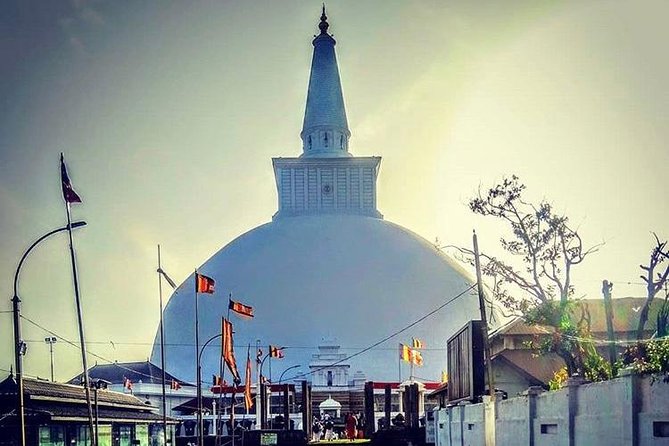
Ruwanwelisaya follows, with about 20 minutes allotted. This is one of Anuradhapura’s major stupas, also known as the Mahathupa or Great Thupa. It is associated with relics of the Buddha, which explains its religious weight and the care given to the monument.
The scale of Ruwanwelisaya contrasts nicely with the intimate opening at the Bodhi tree. Here, you get the grand ceremonial side of Anuradhapura. The short visit means you should expect an overview, not a slow architectural study.
Admission fees are not included at either stop. Since all fees and taxes are separate, ask about the total entrance cost before the morning begins. The $30 rate is a guide price, not the full cost of the outing.
Jetavanarama, Abhayagiri, and Anuradhapura’s monastic power
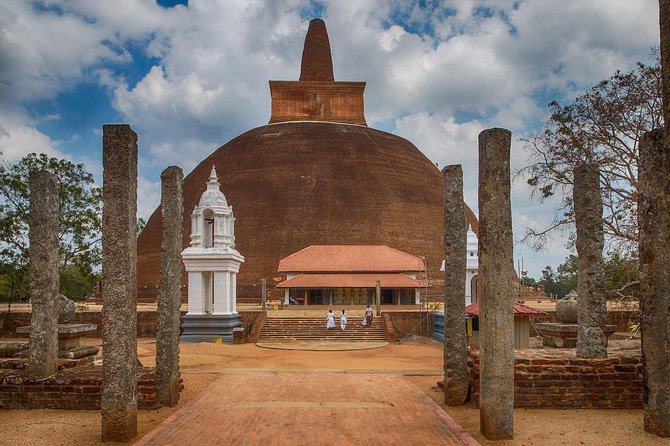
The itinerary then moves into the major monastic areas. One stop is described as the Abayagiriya Stupa, with about 30 minutes allotted, and another is the Abhayagiri Dagaba, with 20 minutes.
The first description refers to the Jetavanarama stupa, also known as Jetavanaramaya, within the ruins of the Jetavana monastery. It is a major Buddhist reliquary monument and part of the UNESCO World Heritage area of Anuradhapura. The second stop focuses on Abhayagiri Vihara, once a major monastic center connected with Mahayana, Theravada, and Vajrayana Buddhism.
These stops are valuable because they show that Anuradhapura was not just a city of isolated stupas. It was also a center of monastic life, study, religious practice, and competing Buddhist traditions. Lampa can help you keep the names and functions straight, since Abhayagiri, Abayagiriya, and Jetavana can easily blur together during a fast visit.
The time allocation is one of the tour’s advantages and limitations. Thirty minutes at one large complex gives you enough time to see the main feature and hear its story. Twenty minutes at the next is enough for a focused stop, but not enough to explore every ruin in detail.
If you want extensive time among the monastic remains, a full-day visit would suit you better. If your aim is to understand the major sites and decide where to return, this condensed route makes good use of a morning.
Same base, a completely different day:
- Minneriya National Park Elephant Jeep Safari Private Tour
★ 5.0 · 68 reviews - Minneriya National Park | Private Safari
★ 5.0 · 59 reviews - Sigiriya Hike & Minneriya Safari Private Full Day Tour
★ 5.0 · 56 reviews - Sigiriya & Habarana: Sunrise Hot Air Balloon Ride Experience
★ 5.0 · 47 reviews
Thuparama and the Samadhi Buddha
Thuparamaya receives about 20 minutes. It is identified as the first Buddhist temple built in Sri Lanka after the arrival of Mahinda Thero, the missionary figure associated with the introduction of Buddhism to the island.
That fact gives Thuparama a special place in the sequence. After the Bodhi tree and the great stupas, you see a site linked with the early establishment of Buddhism in Sri Lanka. It helps explain why Anuradhapura became such an important religious center.
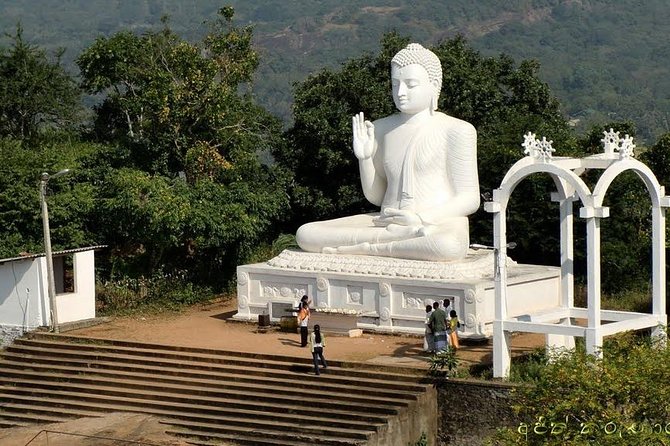
The Samadhi Statue follows, with about 15 minutes. The Buddha is shown seated in the Dhyana Mudra, the meditation posture associated with his first meditation. This is a shorter stop, so listen closely to Lampa’s explanation and take time to look at the expression and pose rather than treating it as another quick photograph.
The two stops work well together. Thuparama gives you an important historical milestone, while the Samadhi Buddha gives you a quieter look at Buddhist artistic tradition. The scheduled times are short, but the sites do not need the same amount of time as the large stupas.
Isurumuniya and the ancient bathing pools
Isurumuniya Temple is scheduled for 30 minutes. The ancient Meghagiri Vihara, also called Meygiri Vihara, is identified with the present Isurumuni Vihara. It was built by King Devanampiya Tissa, who ruled during the early Anuradhapura period.
This stop adds a different texture to the morning. You are no longer looking only at enormous stupas. The temple connects religious life with the early rulers of Anuradhapura, and Lampa’s background in Sri Lankan history can help place it within the wider development of the ancient capital.
The Twin Baths, or Kuttam Pokuna, receive about 15 minutes. These two carefully built bathing pools are among the best-preserved old bathing tanks in Sri Lanka and form part of the Abhayagiri area.
Kuttam Pokuna is a useful reminder that an ancient city depended on practical systems as well as temples. The carved stonework and orderly design show the care given to water and bathing facilities. Since the stop is short, you will want to look at the construction details and ask Lampa how the pools fit into monastic life.
The pair also breaks up the religious monuments with a piece of ancient public works. I like that balance. It gives you a broader sense of how the city functioned.
Wessagiriya and the carved moonstone
Wessagiriya is scheduled for 20 minutes. Also known as Issarasamanarama, it was an ancient Buddhist forest monastery located south of Isurumuniya.
The word forest matters here, since this stop represents a more secluded monastic setting than the great ceremonial stupas. You may find the ruins quieter in character, though the supplied details do not promise a particular crowd level. Lampa’s historical explanation is useful because the remains are less immediately obvious than a giant white stupa.
The final scheduled stop is the moonstone, or Sandakada pahana, with about 20 minutes. This carved semicircular stone usually appears at the bottom of a staircase and is a distinctive feature of ancient Sinhalese architecture.
Do not rush past it. The moonstone is small compared with the surrounding stupas, but it rewards careful looking. Its carved bands and symbolic design show how much attention ancient builders gave to thresholds and movement into sacred spaces.
This is a fitting final stop because it shifts your focus from large religious structures to fine detail. After a morning of huge stupas and ancient monasteries, the moonstone asks you to look down and notice the craftsmanship beneath your feet.
How the $30 price works in practice
The price is $30 per person. That is a reasonable starting point for a private, guide-led half-day tour covering this many major sites, especially if you value explanations rather than simply transport between ruins.
The price does not include all fees and taxes. It also does not include an air-conditioned vehicle. Snacks and water are included, which is helpful during a warm morning, but you should budget separately for admission costs and clarify the transport arrangement.
Pickup is offered, while the stated meeting point is the Jaya Sri Maha Bodhi. Since the details also say the activity starts and ends at the meeting point, confirm whether pickup means collection from your accommodation or simply assistance arranging the start. That small check can prevent confusion on the morning of the tour.
The tour is private, and that improves the value if you want to ask questions or adjust the emphasis. At the same time, the price is less attractive if you mainly want a vehicle and independent sightseeing. The strongest reason to book is Lampa’s interpretation of the monuments.
The brisk schedule and who should book
The listed sightseeing time adds up to almost four hours before driving, transitions, and any delays. That makes the stated three to four hour duration quite tight for all 11 stops.
You should expect short visits at several locations. The itinerary gives 30 minutes to the Bodhi tree, Jetavanarama, and Isurumuniya, but only 15 minutes to Lovamahapaya, the Samadhi Statue, and Kuttam Pokuna. This is a survey tour, not a slow archaeological walk.
I would choose it if you have one morning in Anuradhapura, want the main sacred sites, and prefer a guide who can explain what you are seeing. It also suits first-time visitors who may find the large area and similar-sounding names confusing.
You may want a longer tour if you prefer photography, careful study of ruins, or unhurried time at each temple. The supplied tour information also indicates that Lampa has led longer trips linking Anuradhapura with Mihintale, so you can ask about a fuller plan if the half-day format feels too compressed.
Most people can participate, and public transportation is nearby. The activity requires good weather. If poor weather causes cancellation, you are offered another date or a full refund.
Should you book Travel With Lampa?
Book this tour if you want clear historical and Buddhist explanations, a private group, and a compact introduction to Anuradhapura’s most important sacred places. Lampa’s English, storytelling, and ability to explain the city’s past are the main reasons to choose it.
Skip it if you want a relaxed pace, included entrance fees, or guaranteed air-conditioned transport. The morning covers a lot, but it does so quickly.
For the right visitor, $30 is good value. You receive a licensed guide, snacks, water, and access to a carefully chosen chain of monuments. Just confirm the pickup arrangement, set aside money for entrance fees, and treat the three to four hours as a strong overview rather than the final word on Anuradhapura.
FAQ
How long does the Anuradhapura tour last?
The tour lasts approximately 3 to 4 hours.
What time does the tour start?
The scheduled start time is 8:30 am.
Where does the tour begin?
The stated meeting point is the Jaya Sri Maha Bodhi at 89VW+VV5 in Anuradhapura, Sri Lanka.
Where does the tour end?
The activity ends back at the meeting point.
Are entrance fees included in the price?
No. All fees and taxes are not included in the $30 price.
Is transportation included?
Pickup is offered, but an air-conditioned vehicle is not included. Confirm the exact pickup and transport arrangement before booking.
Is the tour private?
Yes. Only your group takes part in this private activity.
Just added around Anuradhapura
- Yala National Park: 7 hours or 12 hours Leopard Wild Safari★ 4.7 · 11 reviews
- Wilpattu National Park Safari Tour from Kandy★ 5.0 · 3 reviews
- One Day Tour – Sacred city of Anuradhapura & Sacred city of Mihintale. (Sunset)★ 4.5 · 23 reviews
- Wilpattu Half Day Safari From Anuradhapura★ 5.0 · 4 reviews
- Sunrise or sunset tour pidurangala Rock and Sigiriya Rock★ 5.0 · 4 reviews
- Minneriya National Park Half Day Elephant Safari★ 5.0 · 4 reviews
- Adventure safari Experience in Hurulu Eco Park, Sri Lanka★ 5.0 · 18 reviews
- Kaudulla National Park Shared Safari★ 5.0 · 7 reviews
Ancient Cities & Temples, compared.
Kandy to Sigiriya Day Tour and Dambulla cave temple with private vehicle
Read our review →
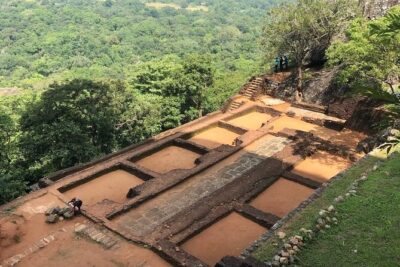
Sigiriya Rock Fortress and Cave Temples Day Trip
Read our review →
Paradise Blow Hole, Big Buddha, Rock Temple Tours
Read our review →
Explore & Ride the history of anuradhapura with Vogel Tours
Read our review →
5 Day Sri Lanka Tour : Including Temple of Tooth & Sigiriya Trip
Read our review →Browse the lists this tour appears in